Updated 8 May 2026
Best Robot Mowers for Steep Slopes (40% and Steeper)
Most consumer robot mowers are rated for slopes between 25% and 35%. A handful — three in our spec database — push past 40%, and one reaches 80%. If your yard has a hillside, terraced section, or steep grade, this is the shortlist that will actually finish the cut without stalling, slipping, or damaging the chassis.
Why slope rating matters
A slope rating is the manufacturer's published maximum grade the mower can drive on without losing traction or tipping. The figure comes from controlled testing on dry, healthy turf. Real-world conditions — wet grass, leaf litter, soft soil after rain, irregular tussocks — typically subtract 5 to 10 percentage points from the rated figure. So a yard with a 45% maximum grade is not a comfortable match for a mower rated at exactly 45%; you want at least 5–10% headroom over your steepest measured slope.
Slope is measured as rise over run, expressed as a percentage. A 100% slope is a 45-degree angle. A 40% slope is roughly 22 degrees — steep enough that walking it sideways is awkward and pushing a regular mower up it is genuinely hard work.
The three mowers rated 40%+
From our spec database of 20 robot lawn mowers, three are manufacturer-rated for 40% slope or steeper. All three are premium-tier models — slope handling at this grade requires either all-wheel drive or a heavy chassis with an aggressive tyre profile, both of which add cost.
1. Mammotion LUBA 2 AWD 5000H — 80% slope

The LUBA 2 AWD 5000H carries the highest slope rating in the consumer robot mower category at 80%. The figure is achieved with a four-wheel-drive chassis, a low centre of gravity, and a 400mm dual-disc cutting head that lets the mower hold position on grades that would defeat a 2WD model. Coverage is rated for 5,000 sqm. Navigation is wire-free RTK with vision obstacle avoidance, and the unit is IPX6-rated for outdoor weather exposure.
See LUBA 2 AWD 5000H on Amazon →
2. Husqvarna Automower 435X AWD — 70% slope

Husqvarna's 435X AWD pairs all-wheel drive with the brand's mature wire-guided platform. The 70% slope rating is the highest of any wire-guided consumer mower currently sold, and the boundary-wire navigation method is more reliable than RTK under heavy tree canopy — relevant for hillside properties where mature tree cover is common. Coverage is 3,642 sqm, runtime is 145 minutes, and IP rating is IPX4. The 435X requires perimeter-wire installation around the mowing area.
3. Husqvarna Automower 450X EPOS — 45% slope
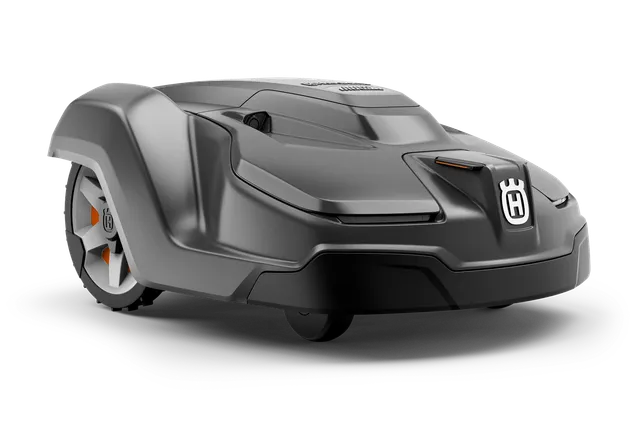
The 450X EPOS is Husqvarna's wire-free flagship. RTK satellite navigation handles boundary mapping without a perimeter wire, and the 10 Ah battery delivers 210 minutes of runtime per charge — long enough to handle the rated 10,117 sqm coverage area in a single cycle. Slope rating is 45%, IP rating is IPX4, and Best matched to estate lawns up to 2.5 acres with clear sky view for the RTK base station.
Navigation tradeoffs on slopes
The choice between wire-guided (Husqvarna 435X AWD), RTK (LUBA 2, Husqvarna 450X EPOS), and hybrid systems matters more on slopes than on flat ground.
- Wire-guided works regardless of sky view. Tree canopy, slope orientation toward the sun, and storm cloud cover do not affect it. The downside is that installing perimeter wire on a steep slope is physically demanding and modifying the boundary later means digging on the same grade.
- RTK gives centimetre-level accuracy under clear sky but degrades when the satellite line of sight is partially blocked. On steep slopes that face away from the satellite constellation's azimuth, accuracy can drop for hours at a time. Vision-equipped RTK mowers (LUBA 2, LUBA 3) compensate by falling back to camera-based localisation when GPS signal weakens.
- Hybrid LiDAR + RTK is the newest stack. The Mammotion LUBA 3 combines 360-degree LiDAR with RTK and dual cameras, which improves boundary precision under canopy. It carries the same 80% slope rating as the LUBA 2 in a more expensive package.
AWD versus 2WD on hills
Two-wheel-drive robot mowers drive the rear wheels and rely on weight distribution to keep the front in contact with the turf. On steep slopes, the front lifts as the chassis rocks back, traction is lost, and the cutting head can scrape the soil if the mower stalls.
All-wheel-drive mowers (Husqvarna 435X AWD, Mammotion LUBA 2/3, all variants) drive every wheel independently. Each wheel gets independent torque, the chassis stays planted, and the mower can climb terraces and embankments that defeat a 2WD model. The cost is a heavier unit, more battery draw, and a higher purchase price.
Which to choose
| If your yard... | Pick | Why |
|---|---|---|
| Has 40–50% slope, open sky view, under 5,000 sqm | Mammotion LUBA 2 AWD | Cheapest of the three, AWD, RTK avoids wire install |
| Has 45%+ slope and heavy tree canopy | Husqvarna 435X AWD | Wire navigation works under canopy; AWD chassis |
| Is over 5,000 sqm and you have clear sky | Husqvarna 450X EPOS or LUBA 2 | Both rated at the high coverage tier; choose by canopy density |
| Has 70%+ terraced sections | Mammotion LUBA 2 AWD (80%) or 435X AWD (70%) | Only two consumer options at this grade |
Use the Lawn-Fit Calculator
Match your specific yard against the full database — including slope, coverage, navigation, and budget — using our Lawn-Fit Calculator. For a deeper read on navigation method tradeoffs, see RTK vs Perimeter Wire vs LiDAR.
Related guides
- Wire-Free Robot Mowers — RTK + LiDAR Roundup
- Robot Mowers for Large Yards (5,000+ sqm)
- Husqvarna 415X vs Mammotion LUBA 2
FAQ
How do I measure my yard's maximum slope?
Use a smartphone level app or a builder's spirit level on a one-metre stick. Tip the stick along the steepest line of fall, measure the rise from horizontal, and divide by one metre. A 0.4 metre rise over a one-metre run is a 40% slope.
Will a steep-slope mower work on a flat yard?
Yes — a 70% rated mower handles a 5% yard without issue. The cost is that you're paying for capability you won't use. A flat yard under 1,500 sqm is well-served by a cheaper mid-tier mower with a 30–35% slope rating.
What about wet grass on slopes?
Manufacturers test slope ratings on dry, healthy turf. Wet grass reduces effective traction by roughly 5–10 percentage points. Most steep-slope mowers include rain sensors that pause operation until the grass dries; using that feature is recommended for any property near the mower's rated maximum.
Are AWD models louder?
Marginally. The Husqvarna 435X AWD is rated at 60 dB, the LUBA 2 at 60 dB, and 2WD models in the same coverage tier sit between 54 and 65 dB. The differences are smaller than you'd expect because cutting blade noise dominates over drivetrain noise.
Sources:
- Husqvarna 435X AWD spec sheet
- Mammotion LUBA 2 AWD spec sheet
- Husqvarna 450X EPOS spec sheet
- Full sourced spec database at /data/mowers.json